AutoWriter AI
What It Really Costs to Live in a Tiny House: A Four-Bucket Teardown
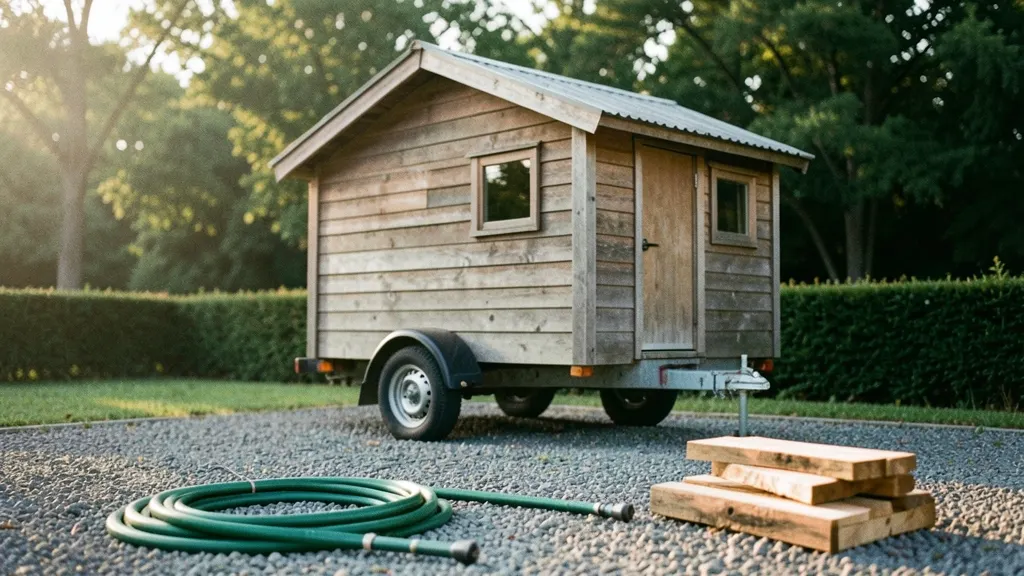
Before you read another build price, open a note and write four headings: the box, the place to put it, the hookups, the ongoing bills. That's the whole tiny house cost question in four lines, and the same house can be cheap in one bucket and brutal in another.
A towable shell you own outright still needs somewhere legal to sit, power and water that work in February, and a yearly bill for insurance and registration that no builder's quote mentions. The rest of this article fills each bucket, then runs a worked example with placeholder figures you swap for local quotes, plus the year-two costs nobody warns you about.
Table of contents
- The four buckets that make up a tiny house budget
- Bucket one: the box, from DIY shell to certified build
- Bucket two: the place to put it, and why zoning decides the price
- Bucket three: hookups, and how each utility choice moves the running budget
- Bucket four: insurance, registration and the bills that arrive annually
- A worked first-year budget with placeholders you replace with local quotes
- The year-two costs that generic tiny house budgets skip
- Where a tiny house genuinely saves money, and where it does not
- Financing a tiny house when lenders do not have a standard product
The four buckets that make up a tiny house budget
A car's sticker price tells you almost nothing about what it costs to own. The purchase is the easy number. Then come the parking space, the fuel, the insurance, the servicing, the tyres, the registration. Nobody budgets for a car by looking only at the dealer's price, yet almost everyone budgets for a tiny house that way.
Split the money into four buckets instead.
- The box. The shell and fit-out: trailer and chassis if it has wheels, framing, insulation, cladding, kitchen, bathroom, wiring, plumbing, finishes.
- The place to put it. Land purchase or lease, parking pad rent, site prep, and the fees and professional help that come with zoning compliance.
- The hookups. Getting power, water and waste sorted, plus propane for heat and cooking. Grid tie-in, solar and batteries, composting toilet, tanks: each choice moves money between this bucket and the next one.
- The ongoing bills. Insurance, trailer registration and roadworthiness, maintenance, and depreciation.
The common misconception is that the glossy build figure is the total. It is one bucket out of four, and often not the biggest. The twin error is assuming a cheap build buys a cheap life. A bargain shell parked illegally, or wired in a way that needs redoing, can cost more per year than a certified build on a serviced pad.
One more thing shapes everything: whether the house sits on wheels or a foundation. That single fact shifts money dramatically between buckets. Wheels usually cut the cost of the box's foundations and raise the cost of the place to put it, the hookups and the annual bills. A foundation does the reverse.
Bucket one: the box, from DIY shell to certified build
The box is the part everyone prices first and understands least. A tiny house shell is not one purchase but a stack of them: trailer or chassis, framing, insulation, cladding, windows, kitchen, bathroom, electrical rough-in, plumbing rough-in, and finishes. Each line has a wide range because each involves a trade-off between labour, material grade and how much you do yourself.
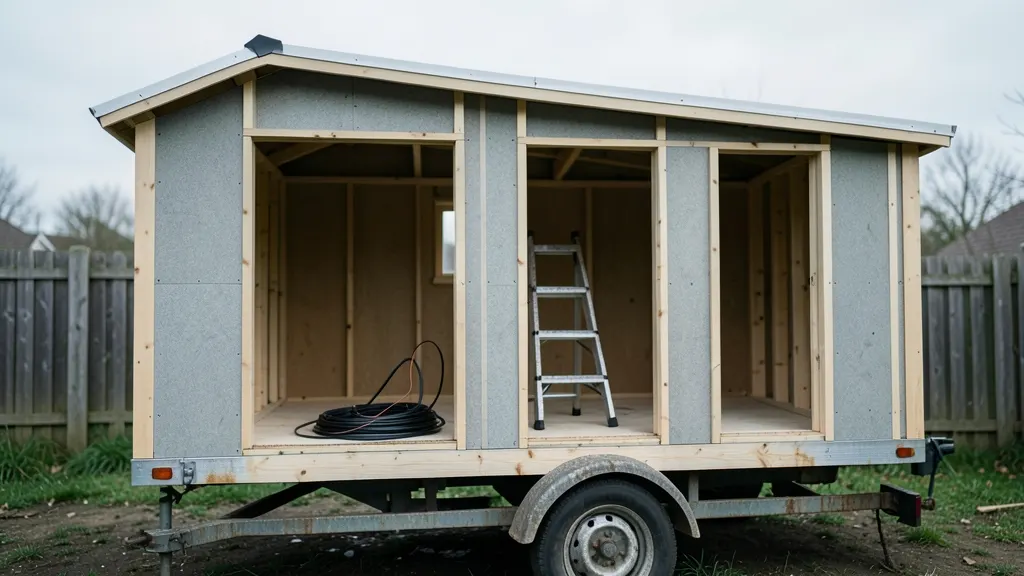
The trailer is the line DIY budgets forget. A roadworthy chassis with brakes, lights and proper rating is a cost in its own right, not a free foundation you happen to tow. Skimp here and you have built a house on a weak spine.
DIY versus professional is not cheaper versus expensive. It is cash versus time, risk and paperwork.
- DIY: lower cash outlay, but a longer timeline, tool purchases you may use once, and mistakes that get paid for twice when they are redone. Self-certification is also harder to insure or finance.
- Professional: higher price, but documented compliance, a warranty, and a paper trail lenders and insurers may ask for.
Certification bodies typically check structural design, trailer attachment, electrical and plumbing work, insulation and ventilation, and compliance with a recognised standard. A certificate is not a guarantee. It does not promise an insurer will cover you, and it does not make a site legal: zoning and siting are separate questions answered by your local authority.
Budget the box by quoting each line separately rather than accepting one lump figure. The total will be honest, and you will see exactly where the money goes.
Bucket two: the place to put it, and why zoning decides the price
Siting is where tiny house budgets go to die. The structure has a ceiling; the place to put it does not. You can spend almost nothing on a borrowed patch of family land or a great deal on a serviced pad in a city, and the legal route decides which of those options is even open to you.
There are three routes, and they price very differently.
- Own land, foundation build. Most like a conventional house: you buy the plot, pour a slab or footings, and pay property tax. Expensive up front, but the most secure and the easiest to insure and finance.
- Own or lease land with a THOW parked on it. Cheaper entry, but you inherit whatever the local rules say about dwelling on wheels as a permanent home.
- Rent a pad in an RV park or mobile home park. No capital outlay, but a recurring fee and park rules that may not welcome a tiny house at all.
That last point is the trap. Three separate rule sets can each kill a given plan in a given place: minimum dwelling size rules (a floor area floor your house may not reach), accessory dwelling unit rules (whether a second small dwelling is allowed at all, and on what terms), and RV-park rules (length limits, age limits, tenure caps). A tiny house that is legal in one county can be unpermittable twenty minutes down the road. You cannot price siting without understanding the rules, so start with our tiny house zoning basics before you phone an agent.
Then the tenure choice. Leasing land keeps your capital free but adds a recurring fee and less security, since the lease can end. Buying ties up capital and adds property tax, but you control the ground under you.
One budget detail people miss: pad rent in a park often bundles water, sewer, or electric. That shrinks your monthly running costs now, and makes the comparison against a bare land lease misleading later. Price the bundle, not the headline rent.
Bucket three: hookups, and how each utility choice moves the running budget
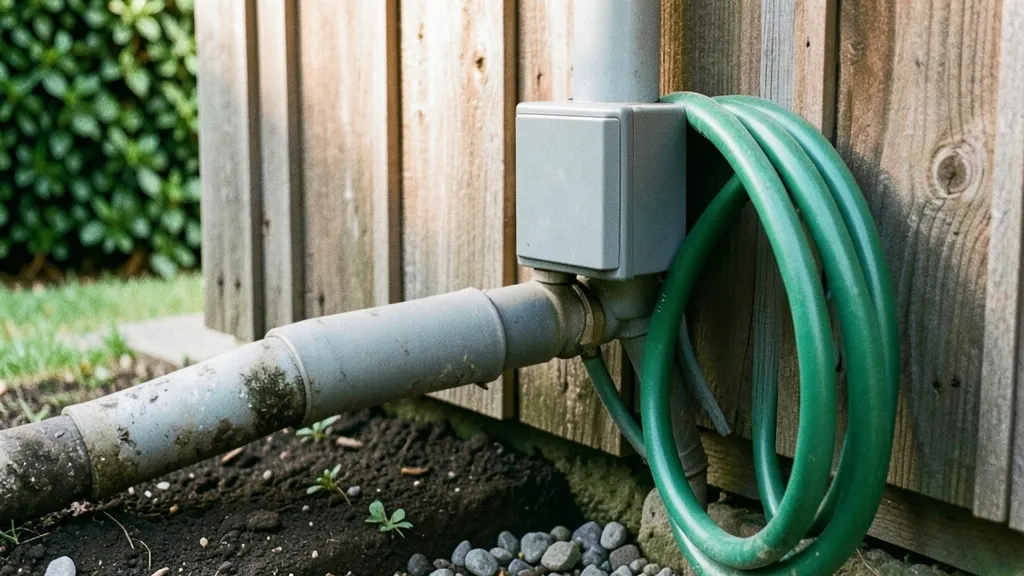
Hookup cost and monthly cost pull in opposite directions. A grid connection is expensive to establish and cheap to run; a solar array is the reverse. The trick is to compare the two numbers together, not one at a time.
| Utility | Setup | Monthly running cost | Watch out for |
|---|---|---|---|
| Electricity, grid | Tie-in fee plus electrician and trenching | Supply charge, then usage | Supply charges accrue even in an empty house |
| Electricity, solar + battery | Panels, inverter, battery bank | Near zero, plus occasional replacement | Capacity drops in winter and low-sun weeks |
| Water, mains | Meter connection and pipework | Metered usage | Connection may not be offered to a THOW |
| Water, tanks | Fresh tank, pump, filler point | Refills, either delivered or hauled | Filling is a chore you repeat forever |
| Waste, composting toilet | Toilet unit, venting, space for the bucket | Management time and cover material | Some jurisdictions do not accept them |
| Waste, flush | Sewer or septic tie-in | Sewer charge or septic upkeep | Septic needs periodic pumping |
| Greywater | Tank and pump-out point | Emptying fees | You cannot legally dump it just anywhere |
| Propane | Bottles and regulator | Refills for cooking and heating | Grid-tied homes forget this line entirely |
Read the table as a seesaw. Pay once at the hookup, or pay every month at the pump-out and refill. Solar looks free until a grey January, when a battery bank sized for summer quietly underperforms. Tanks look cheap until you count the trips.
Compounding it all: no single setup is guaranteed to pass inspection everywhere. Composting toilets, greywater discharge and off-grid electrical systems are treated differently from one jurisdiction to the next, so confirm the local rules before you buy the kit.
Bucket four: insurance, registration and the bills that arrive annually
The build quote is the easy number to find and the least useful one to stop at. The annual bills are where a tiny house either behaves like a cheap apartment or like a second vehicle you also sleep in.
- Insurance is the awkward one. Movable dwellings do not fit the standard homeowner policy template. Some insurers underwrite a THOW as a vehicle (often bundled with the tow rig), others as a structure, and some simply decline. Ask three brokers the same question: "Is this insured as a vehicle or a structure, and what happens if it is damaged while being towed?" The answers will differ, and so will the premiums.
- Registration and roadworthiness. If the house moves at all, expect trailer registration, periodic inspection, and the towing costs themselves: fuel, a suitable vehicle, and wear on both. A house that never leaves its pad still needs the trailer legal if it sits on a public road.
- Property tax or rates. A foundation build usually attracts local property tax like any dwelling. A THOW may be taxed as a vehicle, as personal property, or not at all, depending on where it sits and how the local authority classifies it. Confirm this before you buy the land, not after.
- A maintenance reserve. Seals, roof coatings, paint, appliances and water or heating systems wear on roughly the same calendar as in a full-size house. Fewer square metres means fewer materials, not slower decay. Set aside a monthly figure and treat it as non-negotiable.
- Depreciation. A THOW is a vehicle-like asset; a foundation build is a structure. Neither comes with a guaranteed resale trajectory, so budget as if the money is spent, not parked.
A worked first-year budget with placeholders you replace with local quotes
Copy this table into a spreadsheet and treat every figure below as a placeholder. The numbers are illustrative shapes, not quotes. Your job is to replace each one with a local figure you can point to.
| Line item | Year one (example only) | Steady-state year (example only) | Your quoted figure |
|---|---|---|---|
| Box (shell or certified build) | 40,000 | 0 | |
| Trailer and chassis | 6,000 | 0 | |
| Land purchase or pad lease | 15,000 | 3,000 | |
| Hookups (power, water, waste) | 4,000 | 0 | |
| Insurance | 700 | 700 | |
| Registration and roadworthiness | 300 | 300 | |
| Maintenance reserve | 1,000 | 1,500 | |
| Utilities (propane, electric, water) | 1,200 | 1,800 |
Two things jump out. Year one carries almost all the one-off capital: box, trailer, hookup work and any land purchase. The steady-state column is the number that decides whether the lifestyle actually saves you money, because it repeats every year whether or not you build anything new.
The maintenance reserve rises in year two on purpose. First-year faults usually sit with the builder or fall under warranty; after that, seals, pumps, batteries and the roof are yours.
Before you commit, get three local quotes for the two largest lines. Those are almost always the box and the land or pad, and they are the two where a regional price difference can quietly double your total. Everything else is small enough to estimate with a phone call.
The year-two costs that generic tiny house budgets skip
Year one is a shakedown cruise. Everything is new, nothing has failed yet, and the policy you bought at build stage is still in force. Year two is when the systems send their invoices.
Insurance is the first ambush. A policy written while the house was under construction, or sitting unoccupied on a trailer, often will not renew once someone lives in it or it has been towed to a new spot. Expect to re-shop the cover, answer questions about foundations, tie-downs and certification, and possibly pay more for the privilege.
Then the moving parts:
- Composting toilet. Media and bulking material get used up, filters need replacing, and some units want occasional servicing. Small sums, but they recur.
- Solar. Batteries lose capacity over the years. The system that ran everything in year one may need a top-up or a settings rethink.
- Propane. Heating and cooking costs swing with the price of a refill, and a cold snap empties the tank faster than the budget assumed.
If you rent a pad in a park, the lease renewal is where increases show up. Park fees are set by the operator, not by your mortgage.
Resale deserves its own line. A buyer may struggle to get finance or insurance on a movable dwelling, and that lengthens time on market. Budget for carrying costs while it sits.
And if the house moves: towing, permits and re-levelling. None of it is free, and all of it is easier to plan for than to improvise.
Where a tiny house genuinely saves money, and where it does not
The savings are real, but they are narrower than the marketing suggests. They come from three places: less heated volume, fewer possessions, and no mortgage or rent if you already own the land.
Heating a well-insulated 25 square metre box costs less than heating a 90 square metre house. That is physics, not marketing. Fewer possessions also means fewer things to buy, insure, store and replace, though only if you actually stop buying. And the big one: if the land is yours or your family's, you have removed the largest line in most housing budgets. That single fact often explains the whole "tiny houses are cheap" story.
Now the other column. Land or pad rent does not disappear just because the house is small; a serviced pitch can cost as much as a modest flat in some areas. Insurance is often fiddly and priced on agreed value rather than square footage. Utility hookups are priced per connection, not per cubic metre. And a fridge, a hob, a water heater and a solar system cost roughly the same whether they serve 25 square metres or 90.
The classic mistake is comparing a build quote with a house price. The build quote is bucket one. The house price includes land. Add buckets two, three and four before you declare a winner.
One honest note: making a small footprint work usually means getting ruthless about what you keep. That is a storage problem before it is a budget problem.
Financing a tiny house when lenders do not have a standard product
Lenders do not see a tiny house. They see either a house, a vehicle, or an unsecured gamble, and which one depends on three facts: does it have a chassis, is it certified to a recognised standard, and does it sit on land you own?
A foundation build on your own land is the closest thing to a normal mortgage process. Expect a construction loan: the lender releases funds in stages against inspected progress, then converts to a standard mortgage on completion. It is slow and paperwork-heavy, but the rates and terms look like housing finance rather than consumer credit.
A tiny house on wheels is usually financed as an RV or a personal loan. Terms tend to be shorter and rates higher than a mortgage, and many lenders refuse self-built units outright. Some want a professional builder's invoice and a certification before they will even quote.
That is why documentation is not bureaucracy for its own sake. Certification, receipts, plans and a chassis VIN are what let a lender value the asset and an insurer underwrite it. The same file that gets you a loan often gets you cover.
Talk to a broker or lender before you commit to a build. Financing can reshape the budget: a five-year personal loan on a THOW costs far more per month than a mortgage of the same size, and that changes what you can afford to spend on the box itself. If the budget is already tight, the storage ideas for 20 square meters that save you buying a bigger unit may matter less than the loan term.
The rule of thumb: price the finance before you price the house. If you cannot name the lender, the product and the term, the budget is a wish, not a plan.
Frequently asked questions
Can I get a normal mortgage on a tiny house on wheels?
Usually not. Most mortgage lenders want a fixed foundation and a property title, and a trailer-mounted house is treated as a vehicle or a chattel instead. Expect to use a personal loan, an RV or manufactured-home loan, or a specialist lender, and expect shorter terms and higher rates than a standard mortgage. Ask a lender and, if the sums are large, a financial adviser before you commit.
Does a composting toilet really save money over a flush toilet?
It can, but the saving is mostly in the hookup, not the hardware. Skipping a sewer connection or septic system avoids a large one-off cost, while the toilet itself often costs more up front than a standard one. Running costs depend on whether you use a commercial unit with consumables or a simple DIY design, so compare the full install plus five years of use, not the sticker price.
What happens to my tiny house insurance if I move the house to a new spot?
Your policy is tied to how the house is classified and where it sits, so a move usually means notifying the insurer and often re-underwriting the policy. A change from a parked rural pad to a serviced urban lot, or from private land to a commercial park, can shift both the premium and what is covered. Tell the insurer before you tow, not after.
Is it cheaper to build a tiny house on a foundation than on a trailer?
Sometimes, and not by as much as people assume. A foundation avoids the trailer, the towing weight limits and the registration and insurance costs that come with a vehicle, but it adds excavation, concrete, permits and a permanent utility connection. A foundation build only wins clearly when you already own the land and local rules allow a small dwelling there.
How do I estimate pad rent if I have not chosen a location yet?
Build the estimate from a range rather than a single figure. Price three real listings in each region you are considering, note what each includes (power, water, wifi, laundry), and carry the highest figure into your budget as a stress test. Then add a line for the cost of moving the house if the pad falls through.