AutoWriter AI
A Four-Week Dumbbell Plan for 30-Minute Home Sessions
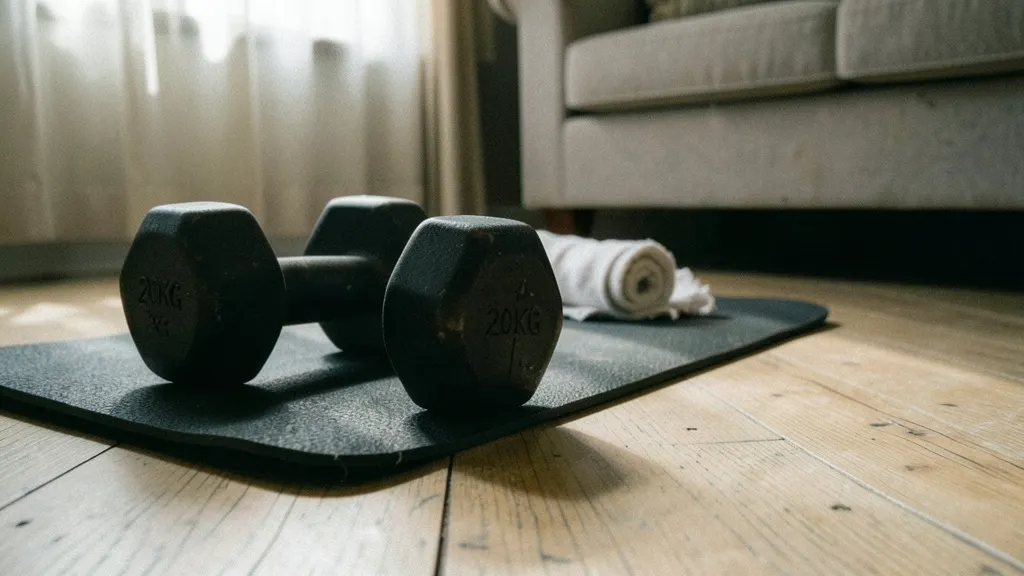
Can you get stronger on 30 minutes a day, three days a week, with nothing but dumbbells? Yes, provided you stop treating the half hour as a vague target and build the session backwards from it. This plan fixes the clock first: 5 minutes of warm-up, 20 minutes of main work, 5 minutes to finish. What changes across four weeks is what fills the middle block, not how long you spend.
By the end of week four you will have completed twelve strength sessions and eight lighter days, and you will know your working weights for six movement patterns: squat, hinge, push, pull, carry and core. You will also have a written record of reps and loads that tells you whether the plan is working, rather than a general feeling that you have been "doing something".
The weekly skeleton is simple: three strength days, two lighter days, and rest wherever it fits your life. Strength days follow the same 30-minute template every time, so you never have to design a session at 9pm. Lighter days are walks, mobility or an easy circuit, and they exist to keep the habit intact when sleep has been poor or the day has run long.
You need one or two pairs of dumbbells, a chair or bench-height surface, a mat if your floor is hard, and a timer. Adjustable dumbbells make progression easier; fixed pairs are fine, and section 5 covers how to keep advancing when the next dumbbell up is too big a jump.
Table of contents
- What You Need Before Day One
- How to Pick a Starting Weight When You Only Own One or Two Pairs
- The 30-Minute Session Template: Warm-Up, Main Work, Finish
- Your Weekly Skeleton: Three Strength Days and Two Lighter Days
- How the Four Weeks Progress When You Cannot Add Weight
- What to Do When the Next Dumbbell Is Too Heavy
- How to Check It Worked at the End of Week Four
What You Need Before Day One
You can start with what is already in the room. The plan needs nothing you have to order, and no piece of it is optional except the last item.
- One or two pairs of dumbbells, adjustable or fixed. You need a light load you can press overhead for about 12 clean reps and a moderate load you can squat or row for about 8 to 10. If you own only one pair, that is workable; the loading section explains how.
- A mat or carpeted floor for the floor press, renegade rows and core work. A thin mat is enough; thick foam makes floor pressing and planks less stable.
- A sturdy chair or low bench for split squats and step-ups. Test it: it should not slide or flex under a single-leg load.
- A timer on your phone or watch. Rest intervals are where most home sessions quietly stretch past 30 minutes.
- Optional: a resistance band for warm-up work or as a pull substitute if you have no bar.
How to Pick a Starting Weight When You Only Own One or Two Pairs
Pick the weight that lets you complete the prescribed reps with good form on every set, finishing the last set with 1-2 reps still in reserve. That reserve is the control. If you could grind out three or four more, the dumbbell is too light.
If the next dumbbell up is too heavy, do not force it. Slow the lowering phase to about 3 seconds and add a brief pause at the bottom. A controlled tempo turns a light dumbbell into a harder set without changing the load.
If you own only one pair, adjust leverage instead of weight:
- Floor press: elevate your feet on a chair to shift load onto the upper chest and arms.
- Goblet squat: take a closer stance to increase the range of motion.
- Rows and presses: switch to single-arm variations so one dumbbell does the work of two.
For the reasoning behind these rules, see how heavy should dumbbells be.
The 30-Minute Session Template: Warm-Up, Main Work, Finish
Three fixed blocks do the work: 5 minutes to warm up, 20 minutes of lifting, 5 minutes to finish. Set a timer for each block and stop watching the clock.
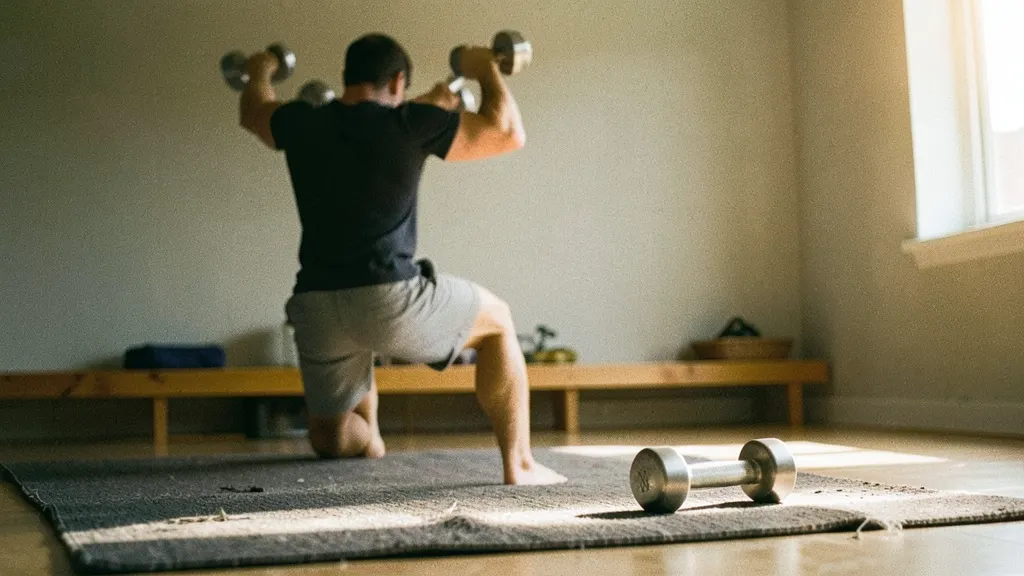
- Warm-up (5 minutes). Spend two minutes on joint circles (shoulders, hips, knees, ankles), then two minutes on light dumbbell swings or halos to raise your temperature. In the last minute, do one ramp-up set of your first main exercise at roughly half your working weight. Skipping the ramp-up set is the most common mistake: the first heavy set then feels like a shock. If you want a ready-made sequence, follow this warm-up before lifting.
- Main block (20 minutes). Pick 3 to 4 exercises and run them as supersets (two exercises back to back, then rest) or straight sets. Rest 60 to 90 seconds between sets: longer for squats and hinges, shorter for rows and presses. Cap the block at 20 minutes even if a set is left undone; the next session is the place to add work, not this one.
- Finish (5 minutes). Choose one: a farmer carry for two or three short walks, a plank held for a few controlled rounds, or slow nasal breathing to bring your heart rate down. This is the cooldown and the core work in one slot, so do not turn it into another lifting block.
Your Weekly Skeleton: Three Strength Days and Two Lighter Days
| Day | Session | Time | What it involves |
|---|---|---|---|
| Monday | Strength A | 30 min | Goblet squat, floor press, single-arm row, farmer carry |
| Tuesday | Lighter day | ~20 min | Walk or mobility work |
| Wednesday | Strength B | 30 min | Romanian deadlift, overhead press, split squat, renegade row |
| Thursday | Rest or easy movement | Optional | Nothing structured, or a short walk |
| Friday | Strength A or B | 30 min | Alternate the two sessions week to week |
| Saturday | Rest or optional light activity | Optional | Walk, easy mobility, nothing taxing |
| Sunday | Rest or optional light activity | Optional | As Saturday |
Three lifting days give each muscle group roughly 48 hours before the next hard session, which is the point of the Tuesday and Thursday gap. Friday alternates A and B so that over four weeks each session appears six times: enough exposure to progress, few enough to recover from.
Treat lighter days as active recovery, not training. A 20-minute walk or five mobility drills for hips, shoulders and ankles is plenty. The goal is blood flow and range of motion, not fatigue. If you feel like you need a hard session on Tuesday, that is a signal the Monday work was too heavy or too long, not that you should add volume.
How the Four Weeks Progress When You Cannot Add Weight
When the dumbbells stay the same, tempo and rest do the work. A fixed load can still feel harder every week if you change how long the muscle is under tension and how much recovery you get between sets.
- Week 1: baseline. Two sets of 8 to 10 reps per exercise. Treat this as a form check: controlled lowering, no bouncing out of the bottom, full range on every rep. Write down the weight and reps so you have something to beat.
- Week 2: volume. Add a third set to each exercise, or keep two sets and add 1 to 2 reps per set. Pick one, not both. If week 1 left you sore for two days, add reps instead of sets.
- Week 3: tempo and rest. Lower every rep over 3 seconds. Cut rest to 60 seconds between sets. The same weight will suddenly feel heavy, which is the point.
- Week 4: combine. Three sets of 10 to 12 reps, 3-second lowering, 60-second rest. If a movement feels easy even now, switch to a single-arm version: one-arm rows, single-arm floor press, suitcase carry instead of farmer carry.
The rule: change one variable per week. If form slips, back off the tempo before you back off the reps.
What to Do When the Next Dumbbell Is Too Heavy
If the gap between your 10 kg and 15 kg dumbbells is too wide, use one of these instead of forcing the heavier pair:
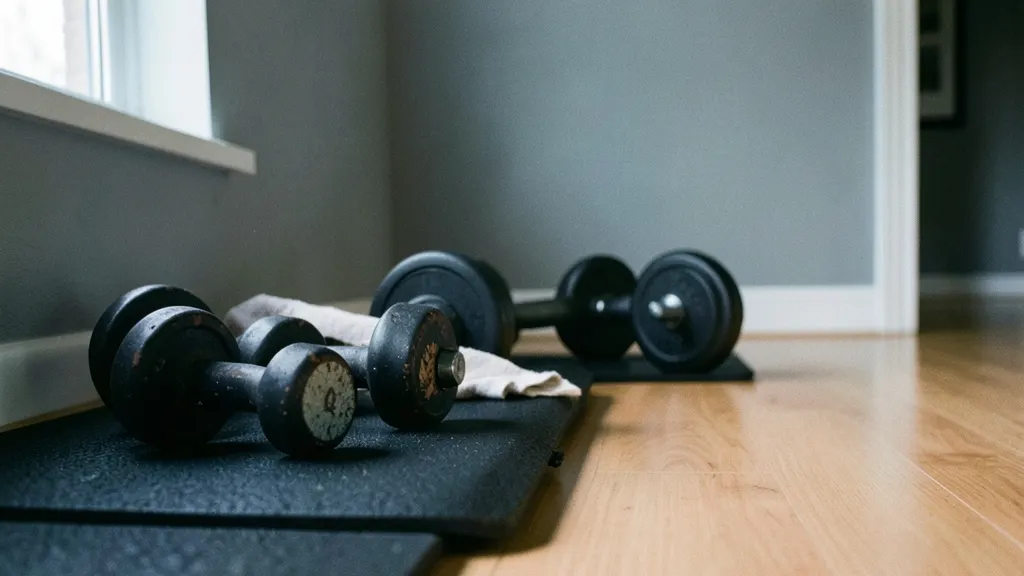
- Go unilateral. A single-arm floor press, single-leg Romanian deadlift or suitcase squat loads one side at a time, so the same dumbbell feels heavier and the working side has to stabilise. Do all reps on one side, then match them on the other.
- Slow the lowering to four seconds and add a two-second pause at the hardest point (chest on the floor press, bottom of the squat). The weight stays the same; the set gets harder.
- Run a mechanical drop set. When you cannot complete the target reps with good form, finish the last few with a lighter dumbbell or a bodyweight version of the same pattern.
- Cut rest to 45-60 seconds between sets. Same weight, same reps, less recovery: more work in the same 20-minute block.
- With adjustable dumbbells, try 1.5 reps. Perform a full rep, then a half rep, and count the pair as one. A small plate jump goes a long way this way.
How to Check It Worked at the End of Week Four
Scale weight and the mirror are the two noisiest signals you have: one moves with water and food, the other is a judgement, not a measurement. Use these instead.
- Reps at the same weight. Take one lift you started with, say the floor press or a row, and retest it in week four with the identical dumbbell. Two or three extra clean reps is progress you cannot argue with. If the number has not moved, check your rest periods and tempo before blaming the plan.
- Form quality. Compare how the movements feel, not how they look. Are your split squats steadier, with less wobble at the bottom? Does the floor press travel in a smoother line? Better control at the same load means the training is landing.
- Recovery between sessions. Notice soreness in the 24 to 48 hours after a session. Less stiffness and faster return to normal usually mean your weekly load is well matched. Persistent fatigue in week three is a signal to hold volume steady rather than add.
Optional: a front-facing photo in the same light and stance on day one and at the end of week four. It is a useful tiebreaker, not the verdict.
If two of the three metrics have moved, repeat the month with slightly harder variations. If none have, the fix is in section 6: change the lever, not the dumbbell.
Today's step: write your week-one numbers down now, before your first session, so week four has something honest to compare against.
Frequently asked questions
Can I do this plan with only one pair of dumbbells?
Yes, as long as you accept that some patterns will feel light and others heavy. Use slower lowering phases, pauses at the bottom, and single-arm versions to add difficulty where the weight is easy. Keep the heavier pair for squats, hinges and carries, and treat pressing and raising as the places where you run out of resistance first.
What if I miss a session or a whole week?
Skip the missed session rather than stacking two strength days back to back, and continue with the next scheduled day. If you lose a full week, repeat the week you were in before moving on, keeping the same loads. Strength returns quickly after a short break, and restarting lighter for one session is better than forcing a personal best on day one.
How do I make the plan harder after four weeks?
Change one variable at a time: add a rep to each set, add a set to the main lifts, slow the lowering phase, or move to a heavier pair. Run another four-week block with the same weekly skeleton and the new target written down. If you have plateaued on every lift, check sleep and protein intake before adding more volume.
Is it okay to do cardio on the same day as strength work?
It is fine, but keep the order sensible: do the strength session first if the cardio is hard, or put easy walking or cycling on your lighter days. Hard intervals immediately before lifting will cost you reps on squats and rows. If you are short on time, a brisk walk on a rest day covers most of what a busy adult needs.
What should I eat before or after these workouts?
A 30-minute dumbbell session does not demand special timing. Eat a normal meal containing protein and carbohydrates one to two hours beforehand if you train early, or train fasted if that suits you. Spread protein across the day rather than chasing a narrow post-workout window, and ask a dietitian if you have specific needs or medical conditions.